 Add to Chrome
 Add to Firefox
 Add to Edge
Multi-Cell 6DMA: Cooperative Interference Management and Antenna Rotation Optimization
May 21, 2026
In this paper, we investigate a multi-cell six-dimensional movable antenna (6DMA) network for enhancing downlink communication performance under inter-cell interference (ICI). Each base station (BS) is equipped with multiple 6DMA surfaces, and the 6DMA rotations affect both the desired-signal enhancement for in-cell users and the interference leakage toward neighboring cells, which makes the antenna-rotation design and transmit precoding intrinsically coupled across BSs. To address this issue, we formulate an average weighted sum-rate maximization problem for the multi-cell system by jointly optimizing the short-term downlink precoders and long-term 6DMA rotations under practical antenna geometric constraints. To tackle the resulting nonconvex problem, we propose a distributed two-timescale design based on inter-cell interference power constraint (IPC) coordination among neighboring BSs, under which each BS performs local short-term precoder optimization based on instantaneous channel state information (CSI) and long-term 6DMA rotation update according to statistical CSI with limited inter-BS information exchange. In particular, an edge-wise IPC coordination mechanism based on two-stage one-dimensional grid search and random maximal matching is developed to enable scalable distributed implementation. A centralized offline benchmark is also provided for performance comparison. Numerical results show that the proposed distributed design achieves performance close to the centralized benchmark under different interference conditions, while maintaining favorable scalability as the network size increases.

Rotatable Coupler Antenna Enhanced Wireless Network: Modeling and Coupler Rotation Optimization
May 19, 2026Flexible coupler antenna systems have recently received significant research interest due to their capability to intelligently reconfigure wireless channels by controlling coupler positions and/or rotations and dynamically exploiting mutual coupling. In this paper, we investigate a new type of flexible coupler antenna, termed rotatable coupler antenna (RCA), for enabling spectrum and energy efficient wireless communication cost-effectively. Specifically, an RCA consists of one fixed active antenna and multiple low-cost passive couplers, each of which can independently rotate in three-dimensional (3D) space, so as to collaboratively achieve mechanical beamforming without requiring additional radio-frequency (RF) chains for the couplers. We study an RCA-enhanced point-to-point communication system, where one RCA is deployed at the transmitter to serve a single user equipped with a fixed antenna. Based on multi-port circuit theory, we establish the channel model and characterize the mutual coupling coefficients as a function of coupler rotations. We formulate a new problem to maximize the received signal-to-noise ratio (SNR) at the user by optimizing the 3D rotations of all couplers, subject to practical coupler rotation constraints. To tackle this nonconvex problem, we develop a spherical-cap conditional-gradient-based algorithm with cross-entropy-method initialization. Simulation results demonstrate that the proposed RCA system can significantly improve communication performance in comparison with benchmark schemes, while requiring substantially fewer active antennas and RF chains.
Flexible Coupler Antenna for Wireless Networks: Opportunities and Challenges
May 19, 2026Flexible coupler antenna (FCA) is a new technique that aims to improve the performance of wireless communication networks by smartly translating low-cost passive couplers around fixed-position active antennas to reshape the induced currents on the passive elements for radiation. Specifically, different couplers can independently control their positions/rotations at the transceiver and thereby collaboratively achieve mechanical beamforming for directional signal enhancement or nulling. The position and/or rotation reconfiguration of passive couplers provides a new and cost-effective means of enhancing wireless communication performance, while significantly reducing the antenna and radio-frequency (RF) chain costs of conventional active arrays. The compact and low form-factor structure of the FCA makes it particularly appealing for devices with stringent size, weight, and power (SWAP) constraints. In this article, we provide an overview of FCA to reveal its promising capabilities in wireless networks, including its system modeling, practical implementation, and competitive advantages over existing techniques. We present a variety of FCA-enabled performance enhancements in terms of mechanical beamforming gain, path-loss reduction, fading mitigation, spatial multiplexing gain, interference suppression, and geometric gain. Furthermore, we elaborate on the design challenges of FCA as well as promising solutions, and discuss the key applications of FCA in wireless networks. Finally, numerical results are presented to verify the substantial capacity gains enabled by FCA-aided transmission in wireless networks.
Does RL Expand the Capability Boundary of LLM Agents? A PASS@(k,T) Analysis
Apr 16, 2026Does reinforcement learning genuinely expand what LLM agents can do, or merely make them more reliable? For static reasoning, recent work answers the second: base and RL pass@k curves converge at large k. We ask whether this holds for agentic tool use, where T rounds of interaction enable compositional strategies that re-sampling cannot recover. We introduce PASS@(k,T), a two-dimensional metric that jointly varies sampling budget k and interaction depth T, separating capability expansion from efficiency improvement. Our main finding is that, contrary to the static-reasoning result, tool-use RL genuinely enlarges the capability boundary: the RL agent's pass-curve pulls above the base model's and the gap widens at large k rather than converging. The expansion is specific to compositional, sequential information gathering; on simpler tasks RL behaves as prior work predicts. Under matched training data, supervised fine-tuning regresses the boundary on the same compositional tasks, isolating self-directed exploration as the causal factor. Mechanism analysis shows RL reweights the base strategy distribution toward the subset whose downstream reasoning more often yields a correct answer, with the improvement concentrated on how the agent integrates retrieved information. These results reconcile optimistic and pessimistic readings of RL for LLMs: both are correct, on different task types.
Flexible Beamforming Design with Hierarchical Rotational 6DMA Systems
Apr 06, 2026Reconfigurable antenna technology, such as movable antennas (MAs) and rotatable antennas (RAs), has emerged as a promising solution to enhance the communication performance of wireless systems by exploiting the new degree of freedom (DoF) in antenna reconfiguration. However, existing RA designs mostly consider the array-wise or antenna-wise rotation only, which constrain their great potential in the wide-range radiation pattern control. To overcome this limitation, we propose a new hierarchical rotational six-dimensional MA (HR-6DMA) architecture to improve downlink coverage, which exploits array-wise rotation for global orientation adjustment and individual antenna rotation for fine-grained radiation refinement. Based on this array architecture, we then formulate an optimization problem to maximize the minimum beamforming gain over a target region by jointly optimizing the two-level rotations and transmit beamforming. To solve this non-convex problem, an efficient algorithm is proposed, where the transmit beamforming and per-antenna rotation are optimized via alternating optimization under any feasible array rotation, followed by a low-complexity linear search to determine the optimal array rotation. Last, numerical results show that the proposed HR-6DMA significantly improves the minimum beamforming gain over fixed and single-level rotatable arrays.
Rotatable Antenna-Empowered Wireless Networks: A Tutorial
Mar 26, 2026Non-fixed flexible antenna architectures, such as fluid antenna system (FAS), movable antenna (MA), and pinching antenna, have garnered significant interest in recent years. Among them, rotatable antenna (RA) has emerged as a promising technology for enhancing wireless communication and sensing performance through flexible antenna orientation/boresight rotation. By enabling mechanical or electronic boresight adjustment without altering physical antenna positions, RA introduces additional spatial degrees of freedom (DoFs) beyond conventional beamforming. In this paper, we provide a comprehensive tutorial on the fundamentals, architectures, and applications of RA-empowered wireless networks. Specifically, we begin by reviewing the historical evolution of RA-related technologies and clarifying the distinctive role of RA among flexible antenna architectures. Then, we establish a unified mathematical framework for RA-enabled systems, including general antenna/array rotation models, as well as channel models that cover near- and far-field propagation characteristics, wideband frequency selectivity, and polarization effects. Building upon this foundation, we investigate antenna/array rotation optimization in representative communication and sensing scenarios. Furthermore, we examine RA channel estimation/acquisition strategies encompassing orientation scheduling mechanisms and signal processing methods that exploit multi-view channel observations. Beyond theoretical modeling and algorithmic design, we discuss practical RA configurations and deployment strategies. We also present recent RA prototypes and experimental results that validate the practical performance gains enabled by antenna rotation. Finally, we highlight promising extensions of RA to emerging wireless paradigms and outline open challenges to inspire future research.
3-D Trajectory Optimization for Robust Direction Sensing in Movable Antenna Systems
Mar 11, 2026This paper presents a novel wireless sensing system where a movable antenna (MA) continuously moves and receives sensing signals within a three-dimensional (3-D) region to enhance sensing performance compared with conventional fixed-position antenna (FPA)-based sensing. We show that the performance of direction vector estimation for a target is fundamentally related to the 3-D MA trajectory in terms of the mean square angular error lower-bound (MSAEB), which is adopted as a coordinate-invariant performance metric. In particular, the closed-form expression of the MSAEB is derived as a function of the trajectory covariance matrix. Theoretical analysis shows that two-dimensional (2-D) antenna movement suffers from performance divergence for target direction close to the endfire direction of the 2-D MA plane, whereas 3-D movement can achieve isotropic sensing performance over the entire angular region. To achieve robust sensing performance, we formulate a min-max optimization problem to minimize the maximum (worst-case) MSAEB over a given continuous angular region wherein the target is located. An efficient successive convex approximation (SCA) algorithm is developed to optimize the 3-D MA trajectory and obtain a locally optimal solution. Numerical results demonstrate that the proposed 3-D MA sensing scheme is able to significantly reduce the worst-case mean square angular error (MSAE) compared with conventional arrays with FPAs and MA systems with 2-D movement only, thus achieving more accurate and robust direction estimation over the entire angular region.
Coupler Position Optimization and Channel Estimation for Flexible Coupler Aided Multiuser Communication
Feb 11, 2026In this paper, we propose a distributed flexible coupler (FC) array to enhance communication performance with low hardware cost. At each FC antenna, there is one fixed-position active antenna and multiple passive couplers that can move within a designated region around the active antenna. Moreover, each FC antenna is equipped with a local processing unit (LPU). All LPUs exchange signals with a central processing unit (CPU) for joint signal processing. We study an FC-aided multiuser multiple-input multiple-output (MIMO) system, where an FC array base station (BS) is deployed to enhance the downlink communication between the BS and multiple single-antenna users. We formulate optimization problems to maximize the achievable sum rate of users by jointly optimizing the coupler positions and digital beamforming, subject to movement constraints on the coupler positions and the transmit power constraint. To address the resulting nonconvex optimization problem, the digital beamforming is expressed as a function of the FC position vectors, which are then optimized using the proposed distributed coupler position optimization algorithm. Considering a structured time domain pattern of pilots and coupler positions, pilot-assisted centralized and distributed channel estimation algorithms are designed under the FC array architecture. Simulation results demonstrate that the distributed FC array achieves substantial rate gains over conventional benchmarks in multiuser systems without moving active antennas, and approaches the performance of fully active arrays while significantly reducing hardware cost and power consumption. Moreover, the proposed channel estimation algorithms outperform the benchmark schemes in terms of both pilot overhead and channel reconstruction accuracy.
Two-stage Multi-beam Training for Multiuser Millimeter-Wave Communications
Jan 07, 2026In this letter, we study an efficient multi-beam training method for multiuser millimeter-wave communication systems. Unlike the conventional single-beam training method that relies on exhaustive search, multi-beam training design faces a key challenge in balancing the trade-off between beam training overhead and success beam-identification rate, exacerbated by severe inter-beam interference. To tackle this challenge, we propose a new two-stage multi-beam training method with two distinct multi-beam patterns to enable fast and accurate user angle identification. Specifically, in the first stage, the antenna array is divided into sparse subarrays to generate multiple beams (with high array gains), for identifying candidate user angles. In the second stage, the array is redivided into dense subarrays to generate flexibly steered wide beams, for which a cross-validation method is employed to effectively resolve the remaining angular ambiguity in the first stage. Last, numerical results demonstrate that the proposed method significantly improves the success beam-identification rate compared to existing multi-beam training methods, while retaining or even reducing the required beam training overhead.
Intelligent Reflecting Surfaces for Integrated Sensing and Communications: A Survey
Nov 14, 2025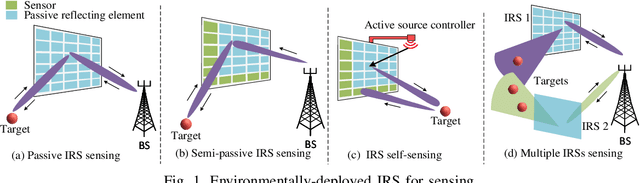

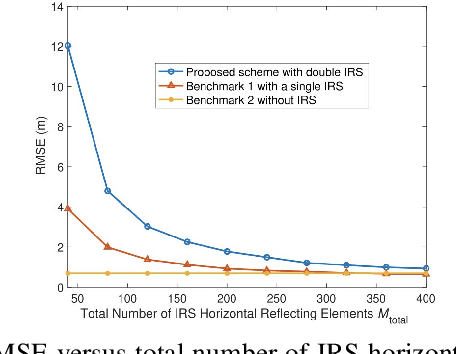
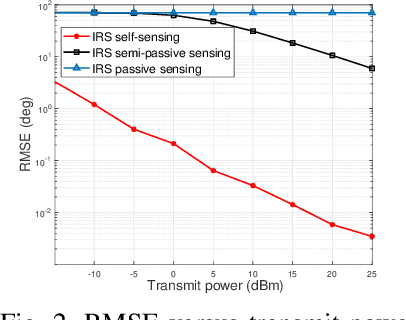
The rapid development of sixth-generation (6G) wireless networks requires seamless integration of communication and sensing to support ubiquitous intelligence and real-time, high-reliability applications. Integrated sensing and communication (ISAC) has emerged as a key solution for achieving this convergence, offering joint utilization of spectral, hardware, and computing resources. However, realizing high-performance ISAC remains challenging due to environmental line-of-sight (LoS) blockage, limited spatial resolution, and the inherent coverage asymmetry and resource coupling between sensing and communication. Intelligent reflecting surfaces (IRSs), featuring low-cost, energy-efficient, and programmable electromagnetic reconfiguration, provide a promising solution to overcome these limitations. This article presents a comprehensive overview of IRS-aided wireless sensing and ISAC technologies, including IRS architectures, target detection and estimation techniques, beamforming designs, and performance metrics. It further explores IRS-enabled new opportunities for more efficient performance balancing, coexistence, and networking in ISAC systems, focuses on current design bottlenecks, and outlines future research directions. This article aims to offer a unified design framework that guides the development of practical and scalable IRS-aided ISAC systems for the next-generation wireless network.